国宝时刻

国宝时刻

翔鹭纹铜鼓

9.0 |12月14日 05:42 |更新至42集/共50集 |共50集
简介:
《国宝时刻》文物超高清影像记录工程,由国家文物局、国家广播电视总局联合指导。用视听语言讲述文物故事,以每集拍摄一件文物、每个文物5分钟的精炼体量制作传播,推动文物从馆舍展陈融入生活场景,让百姓共享文化遗产保护成果,也为世界人民更好地理解中国、读懂中国提供了深刻而生动的窗口。
猜你喜欢
换一换
丹麦小村教堂
328
9.0
HD中字
丹麦小村教堂
9.0
更新时间:2025年02月23日
主演:Ib Koch-Olsen
简介:The history of Danish country church architecture is told by showing scenes of how the church was used by the congregation, beginning with the celebration of mass in a small and simple wooden church 800 years ago, and ending with the congregation singing in a village church of to-day. The development and the growth of the pattern of church architecture is shown.  Dreyer in this film shows a series of churches from different periods with churchgoers in period clothing. Each period is separated by a shot of a church bell double-exposed on the sky. Although the film has a vibrant and instructive way of communicating the different epochs and styles to students, it does not exhibit the artistic quality that usually distinguishes a Dreyer film, except perhaps in some of the costumes, which were originally made for Day of Wrath.  The board of Dansk Kulturfilm in autumn 1945 decided that their planned church film would exclusively be about village churches. Dreyer would rework the script that was written by editor and folk high-school principal Bernhard Jensen, aided by a committee of experts consisting of architect H. Lønborg-Jensen and Victor Hermansen, curator at the National Museum of Denmark. Dreyer had a first draft ready in mid-March, entitled Kirken er et gammelt Hus (The Church Is an Old House), which was distributed to the members of the committee for their comments.  In the last half of July, Dreyer and Victor Hermansen travelled the country to look at suitable churches. They researched the details and at Dreyer’s request a number of technical changes were made to the churches, including the removal of porcelain holders for electrical wiring in Tveje Merløse Church.  On 4 July, Dreyer went in advance to Ringkøbing. Shooting was set to start a few days later with the arrival of the director of photography, Preben Frank, who had fallen off a ladder and broken his leg, Fortunately, he was ready to cautiously start working again within a few days, with his leg in a cast.  Otherwise, the production went without a glitch. Everywhere, Dreyer said, they were well received at the vicarages and they had no problem getting enough extras. On 1 august, they returned to Copenhagen with almost all their footage in the can. They only needed to film the church in Skelby, where the weather had been against them, plus a Swedish wooden church in Hedared. The economy was distressed so soon after the war, especially when it came to foreign currency, but there were no real wooden churches left in Denmark and building an interior set in the studio would be too expensive.  The finished film was shown for the first time on 24 September 1947 to a small, closed circle, which included the Minister for Ecclesiastical Affairs. In December 1947, as was Dansk Kulturfilm’s standard practice, the film was presented to the press, politicians and others on a programme with four other short films.
8343
1947
丹麦小村教堂
主演:Ib Koch-Olsen
中华未来主义
378
2.0
HD
中华未来主义
2.0
更新时间:2025年02月24日
主演:未知
简介:

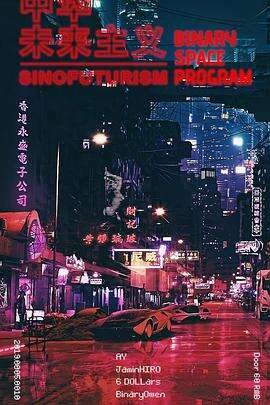
  "Sinofuturism is an invisible movement. A spectre already embedded into a trillion industrial products, a billion individuals, and a million veiled narratives. It is a movement, not based on individuals, but on multiple overlapping flows. Flows of populations, of products, and of processes. Because Sinofuturism has arisen without conscious intention or authorship, it is often mistaken for contemporary China. But it is not. It is a science fiction that already exists.
  Sinofuturism is a video essay combining elements of science fiction, documentary melodrama, social realism, and Chinese cosmologies, in order to critique the present-day dilemmas of China and the people of its diaspora.
  With reference to Afrofuturism and Gulf Futurism, Sinofuturism presents a critical and playful approach to subverting cultural clichés.
  In Western media and Orientalist perceptions, China is exotic, strange, bizarre, kitsch, tacky, or cheap. In its domestic media, China portrayed as heroic, stable, historic, grand, and unified. Rather than counteract these skewed narratives, Sinofuturism proposes to push them much further.
  By embracing seven key stereotypes of Chinese society (Computing, Copying, Gaming, Studying, Addiction, Labour and Gambling), it shows how China's technological development can be seen as a form of Artificial Intelligence."

1674
2016
中华未来主义
主演:
评论区
首页
电影
连续剧
综艺
动漫
演员